How Much Life Insurance Do You Need in Nepal? Calculate the Right Amount
Most Nepali insurance buyers choose their sum assuredThe coverage amount your family receives on death — or you receive at maturity. Full definition → based on what their agent suggests, or whatever premiumThe regular payment you make to keep your insurance policy active. Full definition → fits within their monthly budget. Both are the wrong starting point.
The right sum assured should answer one question: if you died tomorrow, how much money would your family need to maintain their current standard of living?
This guide gives you three proven methods to calculate the right number, real NPR examples, and guidance on what that coverage costs across Nepal’s 14 NIA-licensed life insurers.
Why Most Nepali Families Are Underinsured
A large share of Nepali families still have no life insurance at all, and among those who do, underinsurance is equally damaging.
A family that receives NPR 5 lakh after losing their primary earner might cover funeral costs and two to three months of expenses. Without an income replacement, most families face serious financial difficulty within a year regardless of their insurance payout.
The goal of life insurance is not to pay for the funeral. It is to replace your income for long enough that your family can rebuild financial stability.
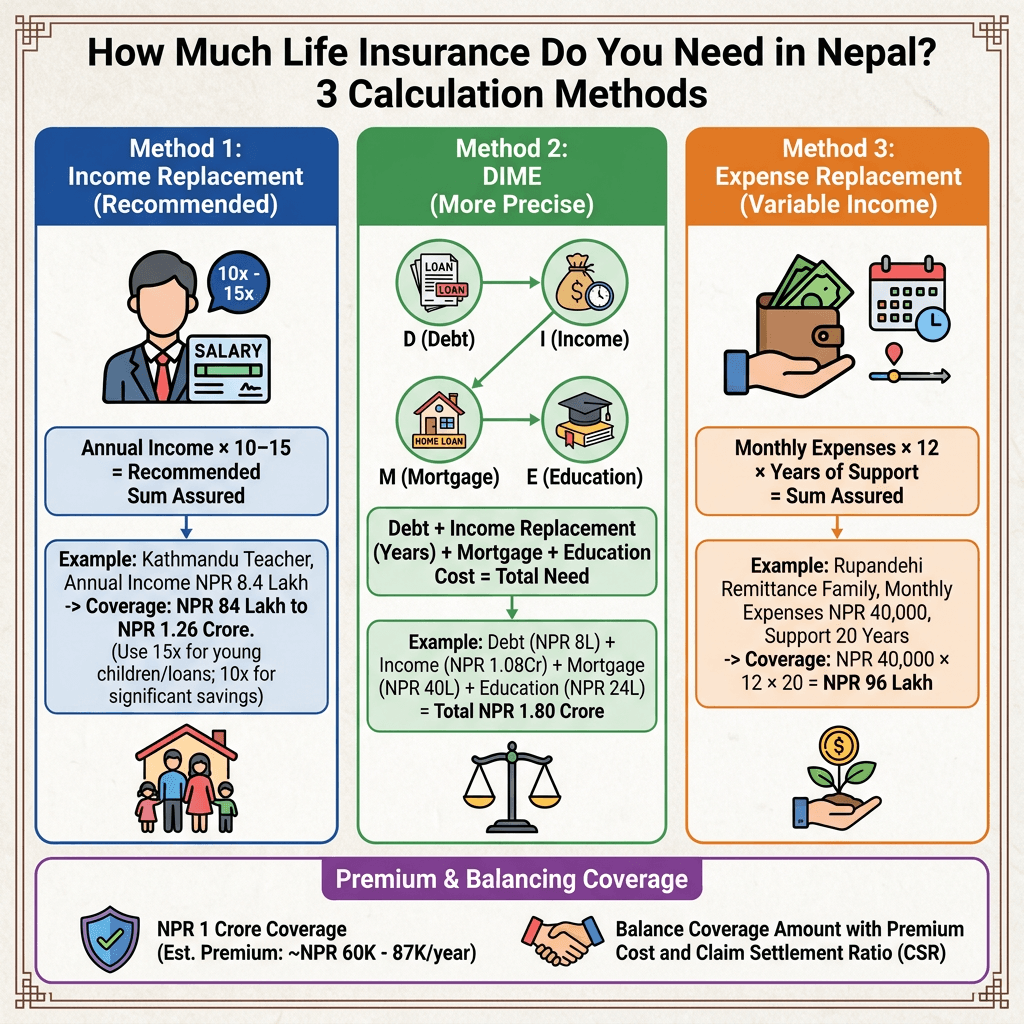
Method 1 — Income Replacement (Recommended Starting Point)
Multiply your annual income by 10 to 15.
Formula: Annual income × 10–15 = Recommended sum assured
Example — Government teacher in Kathmandu:
Monthly salary: NPR 70,000 → Annual income: NPR 8,40,000
Recommended sum assured: NPR 84 lakh to NPR 1.26 crore
Example — Private sector employee in Pokhara:
Monthly salary: NPR 45,000 → Annual income: NPR 5,40,000
Recommended sum assured: NPR 54 lakh to NPR 81 lakh
Example — Small business owner in Birgunj:
Monthly net income: NPR 60,000 → Annual income: NPR 7,20,000
Recommended sum assured: NPR 72 lakh to NPR 1.08 crore
Use 10x if you have significant savings and assets. Use 15x if you have young children, outstanding loans, or limited household savings.
Method 2 — DIME Method (More Precise)
Add four numbers together: Debt + Income + Mortgage + Education.
D — Non-housing debts: Vehicle loans, personal loans, credit card balances.
Example: Vehicle loan NPR 6L + personal loan NPR 2L = NPR 8L
I — Income replacement: Annual income × years until youngest child is financially independent.
Example: NPR 6L/year × 18 years = NPR 1.08 crore
M — Mortgage/housing loan: Outstanding home loan balance.
Example: NPR 40L remaining
E — Education: Estimated higher education cost for all children.
Example: 2 children × NPR 12L each = NPR 24L
Total: NPR 8L + NPR 1.08Cr + NPR 40L + NPR 24L = NPR 1.80 crore
This may seem like a large number, but term insurance for NPR 1.80 crore is more affordable than most people expect.
Method 3 — Expense Replacement (For Variable Income Earners)
For remittance workers, farmers, and self-employed individuals with irregular income, calculate from monthly household expenses instead.
Not sure which plan fits you? Answer 5 questions and get a personalised match.
Find My Plan →Formula: Monthly household expenses × 12 × years of support needed = sum assured
Example — Remittance family in Rupandehi:
Monthly expenses: NPR 40,000
Support needed: 20 years
Sum assured: NPR 40,000 × 12 × 20 = NPR 96 lakh
Example — Farming family in Chitwan:
Monthly household cost: NPR 22,000
Support needed: 15 years
Sum assured: NPR 22,000 × 12 × 15 = NPR 39.6 lakh → round up to NPR 40 lakh
What That Coverage Costs
Term insurance is the most affordable way to buy a large sum assured: a healthy adult can cover tens of lakhs of rupees for a modest annual premium. One thing to know before you shop: across Nepal’s 14 licensed life insurers, base term rates for the same age, term, and sum assured sit close together, so the same profile produces broadly similar premiums almost everywhere. The gap between the cheapest and dearest insurer is usually a few hundred to a couple of thousand rupees a year, not a deciding factor.
Because the premium depends on your exact age, term, and sum assured, the honest way to see your own number is to run it. Enter your details in our free premium calculator to see what your coverage costs across all 14 companies, ranked cheapest first.
The Balancing Act — Coverage vs Cost
Since premiums for a given plan sit close together across insurers, price is rarely the right thing to choose on. What actually varies between companies is their claim settlement record, bonusExtra money declared annually by the insurer on top of your sum assured. Full definition → rates, and financial strength. Buy enough coverage first; then pick the insurer on those, not on a few hundred rupees of premium.
On claim settlement, read the headline ratio carefully. The settlement ratios we publish are an amount-based measure we derive from each insurer’s paid and outstanding claim figures (Nepal Beema Pradhikaran does not publish a per-company settlement ratio). A higher ratio means a larger share of claim value was settled rather than left outstanding at year-end; it is not the probability that your individual claim will be paid or rejected. Read the full method and every company’s numbers on our claim settlement ratios page.
There is no universally right answer. Decide how much cover your family needs, confirm the insurer is comfortably solvent and settles claims well, and treat the premium difference as a tiebreaker rather than the headline.
Adjusting Your Number
Subtract existing assets that could support your family: provident fund balance, fixed deposits, property that could be sold or rented, other insurance policies already in force.
Add if you have dependents with special needs — an elderly parent, a sibling with a disability, a child requiring ongoing medical care — who would need support beyond your family’s general living expenses.
Remittance workers: Your coverage should be large enough to replace the remittance income stream if something happens to you while abroad. Also confirm that your policy covers death outside Nepal — all 14 Nepal insurers cover overseas death as standard, but verify the exclusion clauses in your specific policy document.
Stay-at-home spouses: Even without a formal salary, the economic value of a stay-at-home spouse’s contribution — childcare, household management, family support — is real and should be covered. All 14 Nepal insurers issue policies for homemakers at standard rates.
A Practical Budget Guide
If budget is your primary constraint, here is a simple approach:
Start with whatever sum assured gives you an annual premium of no more than 5–8% of your monthly salary. For a monthly salary of NPR 50,000, that is NPR 2,500–4,000 per month or NPR 30,000–48,000 per year. At that budget, you can buy NPR 50–75 lakh of term coverage from several of Nepal’s 14 companies.
As your salary grows over time, increase your coverage through a new policy or a riderAn optional add-on benefit you attach to your base policy for extra protection. Full definition → on your existing policy.
Use Our Tools
Run the exact calculations for your specific age, coverage amount, and term using our free premium calculator. Then use the plan comparison tool to put your shortlisted plans from any of the 14 companies side by side.
If you want guidance on the right coverage amount for your specific situation, request a free consultation with one of our verified independent agents.
Premium figures are estimates. Actual premiums depend on age, health history, underwritingThe process by which an insurer evaluates your health and risk before issuing a policy. Full definition →, and policy term. Always verify with the insurer before purchasing.