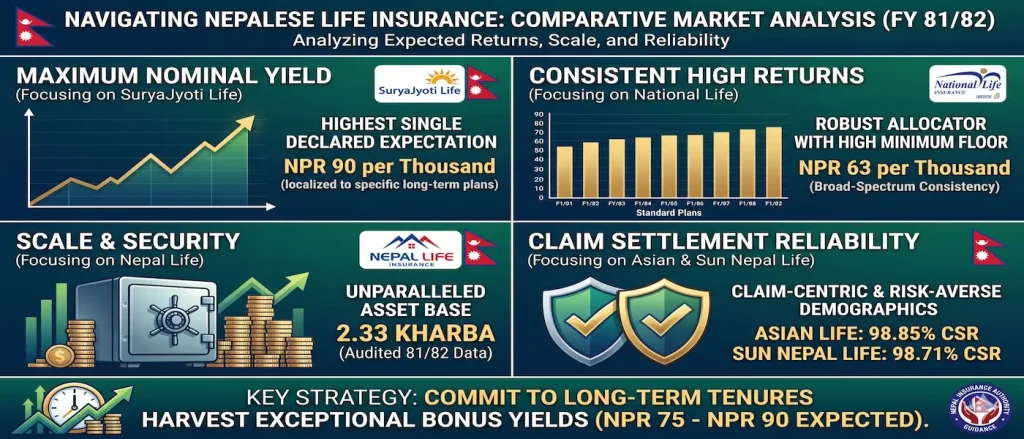
Every year, Nepal’s life insurers declare a bonusExtra money declared annually by the insurer on top of your sum assured. Full definition → on their participating (with-profit) policies: an amount, set after an actuarial valuation and approved by the Nepal Insurance Authority (NIA), that is added to your policy for each NPR 1,000 of sum assuredThe coverage amount your family receives on death — or you receive at maturity. Full definition →. This guide explains the bonus rates declared for fiscal year 2081/82, how the bonus is actually generated, and the one thing most buyers get wrong when comparing it across companies.
All 14 NIA-licensed life insurers have approved bonus structures for FY 2081/82. The one exception on a fresh declaration is the state-owned Rastriya Jeevan Beema, which did not announce a revised rate for this cycle.
How a Life Insurance Bonus Is Generated
Most retail life policies in Nepal are participating, which means the policyholder is contractually entitled to a share of the insurer’s distributable surplus. That surplus comes from three sources: the interest surplus (when the insurer earns more on its investments than it assumed when pricing the policy), the mortality surplus (when actual claims are fewer than projected), and the expense surplus (when running costs come in below the loadings built into the premiumThe regular payment you make to keep your insurance policy active. Full definition →).
At the end of each fiscal year an appointed actuaryThe specialist who calculates premium rates and financial reserves for insurance companies. Full definition → calculates the life fund’s surplus. Once the NIA approves it, a portion is distributed to participating policyholders as a reversionary bonus, expressed as a fixed amount per NPR 1,000 of sum assured per year. Because the bonus tracks the insurer’s investment returns and claims experience, it is declared yearly and is not guaranteed in advance. You can model how bonuses build up over a policy term in our premium calculator.
Declared Bonus Ranges for FY 2081/82
The table below lists the range of declared bonus rates for each insurer’s participating plans in FY 2081/82, per NPR 1,000 of sum assured per year. It is ordered alphabetically, not as a ranking.
| Life Insurance Company | Lowest declared bonus (per NPR 1,000) | Highest declared bonus (per NPR 1,000) |
|---|---|---|
| Asian Life | 45 | 62 |
| Citizen Life | 38 | 73 |
| Himalayan Life | 32 | 63 |
| IME Life | 32 | 70 |
| LIC Nepal | 49 | 65 |
| MetLife Nepal | 50 | 70 |
| National Life | 64 | 85 |
| Nepal Life | 60 | 82 |
| Prabhu Mahalaxmi Life | 33 | 70 |
| Rastriya Jeevan Beema | No revised rate declared for FY 2081/82 (confirm the applicable rate with the company) | |
| Reliable Nepal Life | 25 | 75 |
| Sanima Reliance Life | 35 | 70 |
| Sun Nepal Life | 33 | 70 |
| SuryaJyoti Life | 40 | 75 |
Source: each insurer’s FY 2081/82 actuarial bonus declaration (reported by Beemapost and Insurance Khabar). Figures are per NPR 1,000 of sum assured per year.
How to Read This Table (Important)
It is tempting to scan the right-hand column and crown whoever shows the highest number. Do not. These ranges are not built on a like-for-like basis, so they are a reference, not a scoreboard:
- Each insurer sells many plans. One company’s range might span its endowment and whole-life plans; another’s might be a single flagship endowment. You are not comparing the same thing across two columns.
- The high end is conditional. Top bonus rates are almost always tied to the longest policy terms (often 25 years and above). A 15-year plan at the same insurer will earn a lower rate.
- The rate that matters is the one on the plan you actually buy. Before you commit, ask the insurer for the declared bonus on that specific plan and term, in writing, and remember it is reviewed every year.
In short: use the table to see the lay of the land, then compare on the exact plan you are considering, not on a headline number. Our plan comparison tool puts specific plans side by side.
Not sure which plan fits you? Answer 5 questions and get a personalised match.
Find My Plan →Why Bonus Rates Differ by Plan Type
Within any one insurer, the bonus generally follows the plan’s design:
- Endowment and whole-life plans tend to carry the highest bonuses, because the insurer can lock your premium into long-dated investments and match its long-term liabilities.
- Anticipated (money-back) plans usually sit lower, because the insurer has to keep funds liquid to pay you survival benefits part-way through the term.
- Pure term plans pay no bonus at all. They are protection only, with no savings component, which is exactly why they are the cheapest way to buy a large sum assured.
So a longer commitment generally harvests a higher bonus, but that is a trade-off against liquidity, not a free lunch. If you may need access to your money sooner, the headline bonus on a 25-year plan is not really available to you.
Bonus Is the Second Filter, Not the First
A high bonus is worth little if the insurer is slow or difficult when your family files a claim. Before bonus, look at the insurer’s claim settlement record and financial strength; treat the bonus as the growth filter you apply after you are satisfied on those.
We rank all 14 insurers on our derived, amount-based claim settlement ratioHow reliably an insurer pays out claims, measured from claim amounts paid versus amounts outstanding. Higher is better. Full definition → on the claim settlement ratios page, with the method explained in full. Read that alongside this bonus data before you decide.
The Tax Angle
The bonus is not the only return. Under Nepal’s Income Tax Act 2058, a resident individual can deduct life insurance premiums from taxable income, capped at the lower of the actual premium paid or NPR 40,000 per year. A separate deduction of up to NPR 20,000 applies to health insurance premiums.
For someone in a 20 to 30 percent marginal tax band, a full NPR 40,000 deduction is worth roughly NPR 8,000 to NPR 12,000 in tax saved each year. That is a real benefit on top of the bonus, but it is capped, so it is not a reason to buy a larger policy than you need. The full rules are in our guide to life insurance tax benefits.
The Bottom Line
Bonus rates are a genuine part of a participating policy’s return, but they are easy to misread. Do not pick an insurer off the highest number in a table. Decide how much cover your family needs, confirm the insurer settles claims well and is financially sound, then compare the declared bonus on the specific plan and term you are actually buying.
Not sure where to start? Our plan finder matches you to suitable plans in a few questions, and the premium calculator shows what each costs.